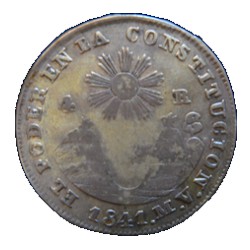
Ecuador, 2 Hills Design
4 reales, 1841
Daniel Sedwick Auction
October 2011, lot# 1107
This is the Republic of Ecuador's 1st coin design.
Known as the "Two Hills Design" it was issued on 1/2 - 2 reales starting in 1833.
Due to the large number of counterfeit "Two Hills" 2 reales, their production was
halted on 11 Oct, 1841. All of the other 2 Hills minors were also discontinued. The 4 reales of this design was then authorized on Nov 2nd, 1841 to
remove them from circulation. Mintage commenced on 30 Nov and to discourage counterfeiting
the 4R's had a very crude raised lettered edge: "MORAL INDUSTRIA".
They were well received by the public and were issued 1841 thru 1843.
fineness = .666 silver, 13.3 gr.
assayer: Miguel Vergara hence the "M.V."
This coin is also a Moneda Feble issue.
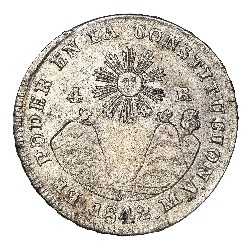
Ecuador 2 Hills Design
4 reales, 1842, NGC-53
May 4th 2023, lot# 920
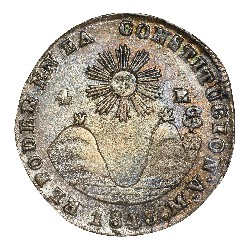
Ecuador 2 Hills Design
4 reales, 1843, NGC-55
May 17th 2023, lot# 71350
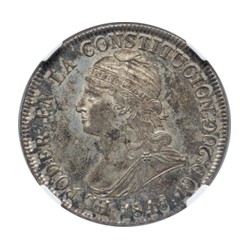
Capped Liberty Bust
8 reales, 1846, NGC-63
Sep. 3rd 2026, lot# 33150
I bid on the Milennia coin in person, going to LA in 2008, but being quite frugal, didn't come close to winning it. I bid on an unc one (same 63) again in 2025 but was out bid. Finally I got this in 2026 via a phone bid. So persistence pays off?
Oh, I have to add that the obverse rotation in the slab was off 15o CW and the reverse was off ~ 17.5oCCW. Thus basically "6h" or "standard coin rotation". It stands to reason that they'd be careful in making these.
Due to counterfeiting of the 1844 and 1845 4 Reales, a law was signed in December 1845 forbidding the local circulation of coins of "the national design". To avoid this, the new administration later in Dec. came up with a new design for the 1846 crowns to circumvent that law. The US "Liberty Capped Bust design of John Reich's, then almost current on US coinage was used. As this coin was .9027 fine silver, it was also legal tender in the US for 1 dollar, making it the only issuance of a Capped Bust silver dollar available.
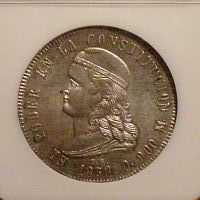
Ecuador, 5 francs, 1858
uncirculated (NGC-65)
(called 5 francos in recent literature) (M.L. Teller, , 2002)
-- update coming soon
At the time between 1833 and 1858 the Ecuadorian silver coinage was debased. Now (after the liberation from Spain) it was time to be a part of a world market of industrialized nations in exchange for finished goods and raw material including silver coinage. The Ecuadorian government could not even begin the process of modernization without a quantity of coins of sufficiently high fineness to finance foreign exchange. As a result the debased silver would have to be withdrawn from circulation and replaced with a silver crown of 0.900 fineness. So the 5 Francs 1858 crown materialized but could never be sustained for circulation. The great mass of the poor could not make transactions without being defrauded by merchants in the market place.
Counterfeiting existed (0.666 silver) and the import of coining machinery from the United States could not take place to replace the discredited "moneda feble", of 0.666 silver). Then disaster struck at the Quito Mint and there was not even the old machinery left to produce coinage. The 5 Francs were quickly withdrawn from circulation and counterfeit coins increased due to the lack of government issued coinage in circulation.
Do you really want to learn more about the history of Ecuadorian coinage in English? Get a copy of Michael Anderson's book "A Numismatic History of Ecuador". Excellent!!!
"business.fortunecity.com/crown/841/reportrare.html" from Chuck Helfand.
Note link no longer valid.
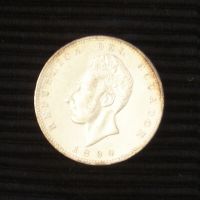
Un Sucre, 1890 UNC

5 Sucres, 1944, EXF
Albigini's Coin Shop, Upper Darby, PA
These were minted in 1943 and 44.
Very similar to the 1 Sucres of the 1880's and 90's but larger in size and .720 fine.